
When you commit to growing tomatoes through the cold winter months—whether in a heated garage, a bright sunroom, or a greenhouse—you are often rewarded with a fresh, flavorful harvest when the rest of the garden is dormant. However, nothing causes more immediate alarm than when those vibrant green leaves start turning yellow. This yellowing, scientifically termed chlorosis, is simply a symptom that your plant is undergoing serious stress or metabolic disruption.
Identifying chlorosis in winter is uniquely challenging because the causes often diverge sharply from those encountered during peak summer growing seasons. In summer, we look primarily at nutrient shortages or soilborne diseases. In winter, however, the most frequent causes are environmental factors—specifically cold, reduced light, and improper watering—that suppress the plant’s ability to function properly, even if its nutritional needs are met.
This guide will help you systematically troubleshoot the issue. Before you decide to reach for a fertilizer—which can often make an environmental problem worse—you must adopt a diagnostic principle: check the fundamentals first. We will explore how extreme cold, low light, and watering errors create “false deficiencies” that look exactly like nutritional shortages, and only then move on to confirming true nutrient issues, pests, and pathogens.
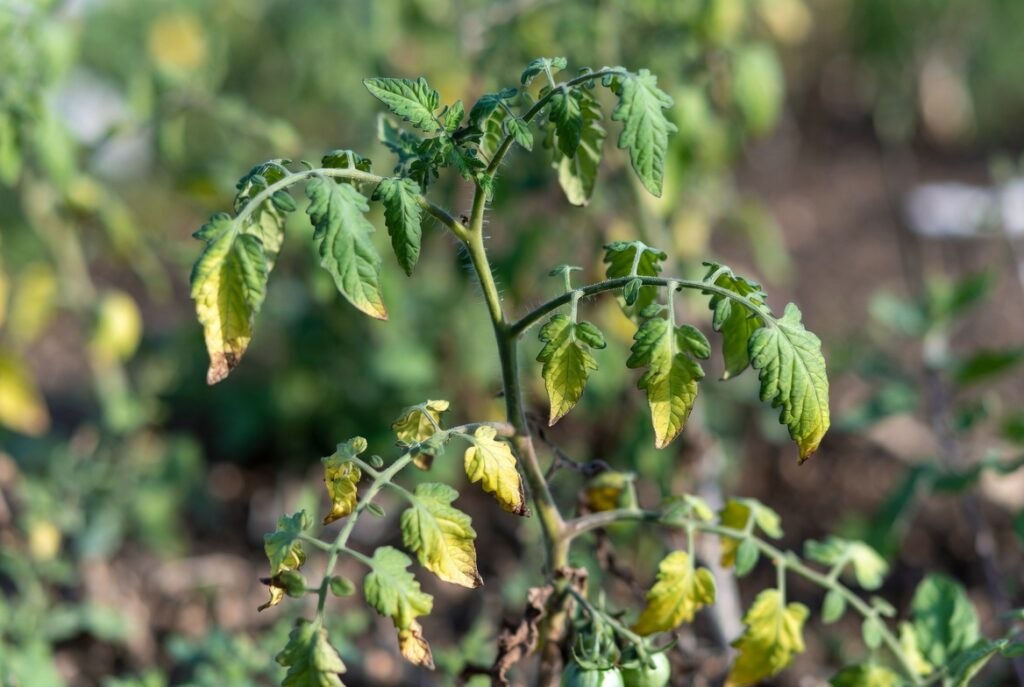
Tomatoes are tropical plants at heart, and when grown indoors or in protective structures during the winter, their entire physiological machinery slows down. The most common causes of winter leaf yellowing are rooted in the physical environment, not in the nutrient supply itself.
Number-1: The Cold Shock—Root Function Shutdown
While your home or greenhouse air temperature might feel perfectly comfortable to you, the temperature of the soil where your tomato roots reside is far more critical. Tomatoes are heat-loving plants, and their roots require a minimum of 60°F (about 15.5°C) to function actively and efficiently. If the soil drops below this threshold, the roots essentially suffer a metabolic slowdown.
This cold stress leads to a phenomenon known as cold-induced nutrient lockup. When the root system is chilled, it cannot efficiently absorb, transport, or process nutrients, regardless of how abundant those nutrients are in the potting mix. This is not a true deficiency of the nutrient in the soil; it is a temporary inability of the root to access it.
A classic example of this is the apparent lack of Potassium (K) absorption. Cold soil may cause leaves to turn purplish or yellow, strongly mimicking a true Potassium or phosphorus deficiency. If the yellowing or purpling is caused by cold soil, the foliage will typically green up again only once the soil temperature is corrected and warms consistently. If you observe these symptoms, your first step should be mechanical, not chemical.
Remedy: Warming the Root Zone
The most effective countermeasure for cold stress is to introduce bottom heat. For container or greenhouse growing, using a heat propagation mat is essential. These mats provide gentle bottom heat directly to the root zone, allowing you to maintain the critical temperature consistently above the 60°F minimum.
When utilizing a heating mat, it is highly recommended that you invest in one with a thermostat and a soil temperature probe. The probe should be inserted directly into the potting mix to measure the actual temperature the roots are experiencing, not just the temperature of the air or the mat surface. This allows you to accurately regulate the heat and ensure your plant maintains the necessary thermal conditions for nutrient uptake. After germination, experienced growers typically allow the soil temperature to drop to around 60°F for established plants.
Number- 2: The Dim Days—Low Light Levels (DLI)
In winter, the sun’s angle is low, and daylight hours are significantly reduced. Tomatoes are high-demand plants that thrive on high light intensity and duration, known as the Daily Light Integral (DLI). A simple sunny windowsill is almost never enough to sustain a mature, fruiting tomato plant.
Insufficient light can cause a general physiological stress that leads to widespread yellowing, or chlorosis. This light deficit reduces photosynthesis, leading to an overall lack of vigor and a pale appearance that can easily be mistaken for a generalized Nitrogen deficiency.
To maintain robust growth and prevent this environmental chlorosis, you must provide supplemental lighting. You should aim to provide your plants with 16–18 hours of light daily to mimic summer conditions. However, be wary of overcompensating; providing constant 24-hour light can cause photoperiodic damage and lead to its own form of chlorosis and reduced yield.
Remedy: Essential Supplemental Lighting
The most efficient solution is using high-quality, full-spectrum LED grow lights. LEDs are preferable to conventional light sources because they offer a complete spectrum, are cost-efficient, and produce significantly less heat, reducing the risk of leaf burn.
For fruiting plants like tomatoes, you need sufficient wattage, typically ranging from 200W to 600W for medium to large coverage areas. It is crucial to monitor the distance between the lights and the plant canopy weekly. Lights should be raised or lowered to remain 12–24 inches above the tallest leaves, ensuring even light coverage and intensity while preventing potential leaf scorching.
Number- 3: The Wet Wait—Overwatering in Reduced Winter Evaporation
Overwatering is arguably the most common cause of yellowing leaves in indoor winter gardens. The three primary environmental stressors are frequently linked: cold temperatures and low light reduce the plant’s metabolic rate and significantly decrease the rate of water consumption (transpiration) and soil evaporation.
This means the soil stays moist for dangerously long periods. Saturated soil starves the roots of oxygen, leading to root suffocation and eventual root rot. Roots that are damaged or drowning cannot absorb nutrients or water, causing the foliage to turn yellow—a symptom of extreme stress.
When the environment is suboptimal (cold and dim), the risk of this problem compounding is high. For instance, if you have cold soil (Culprit 1), the roots already struggle to function. If you then overwater (Culprit 3), you create saturated conditions that compound the inability of the plant to manage nutrients and lead to catastrophic root decline.
Remedy: Adapting Your Winter Watering Schedule
You must drastically reduce your watering frequency compared to outdoor summer growth. Always allow the top inch of soil to dry out completely before you water again. When you do water, ensure it is done slowly and deeply at the base of the plant. Critically, never let your container plants sit in trays or saucers filled with standing water, as this accelerates root suffocation and rot.
The Interconnected Stressors and the Potash Paradox
The close relationship between cold, low light, and watering demands careful attention. When a cold-stressed root system fails to absorb Potassium (K)—resulting in yellowing/purpling leaves—a gardener might logically assume the plant needs more fertilizer. However, if you misdiagnose this environmental lockup as a genuine shortage and subsequently over-fertilize with potassium-rich tomato feed, you can create a secondary problem. Excessive Potassium uptake can actively inhibit the plant’s ability to absorb Magnesium (Mg), thereby creating an actual Magnesium deficiency.
This scenario highlights why addressing the environmental prerequisites—soil temperature and drainage—must always precede chemical intervention. The most successful intervention for yellowing caused by cold is providing heat, not necessarily more nutrients.

Nutrient Deficiency Diagnosis (How to Read the Yellow Map)
Once you have confirmed that your plant has adequate warmth (soil > 60^\circ \text{F}), sufficient light (16–18 hours), and correct watering practices, and the yellowing persists, you should turn your attention to actual nutrient deficiencies.
Accurate diagnosis relies on understanding two key indicators: the location of the chlorosis (old vs. new leaves) and the pattern of the yellowing (uniform vs. interveinal).
Mobile vs. Immobile Nutrients
Nutrients are categorized by their mobility within the plant:
- Mobile Nutrients: These include Nitrogen (N), Magnesium (Mg), and Potassium (K). The plant can move these elements from older, less vital leaves (usually at the bottom of the plant) to support the younger, actively growing tips. Therefore, a deficiency in a mobile nutrient will always appear first in the older leaves.
- Immobile Nutrients: These include Iron (Fe) and Manganese (Mn). Once incorporated into a leaf structure, they cannot be readily moved. A deficiency in an immobile nutrient will therefore manifest first in the youngest leaves at the top of the plant.
Uniform vs. Interveinal Chlorosis
- Uniform Yellowing: This is characterized by the entire leaf surface, including the major veins, turning pale yellow. This usually points strongly to Nitrogen deficiency.
- Interveinal Chlorosis: The tissue between the veins turns yellow, but the veins themselves remain clearly green. This pattern is indicative of deficiencies in Iron, Magnesium, or Manganese.
these patterns will allow you for precise identification:
| Nutrient Deficient | First Leaves Affected | Chlorosis Pattern | Key Differentiator & Context |
| Nitrogen (N) | Older Leaves (Bottom) | Uniform yellowing (veins turn yellow) | General stunting and lack of vigor. Easily leached from container soil. |
| Magnesium (Mg) | Older Leaves (Bottom) | Interveinal chlorosis (veins remain green) | Yellow patches may progress to brown necrosis. Often induced by high potassium levels. |
| Iron (Fe) | Youngest Leaves (Top) | Interveinal chlorosis (veins remain green) | Almost exclusively related to high soil pH (alkaline lockup). |
| Potassium (K) | Older Leaves (Bottom) | Marginal scorching/yellowing at leaf edges | Can be confused with cold-induced lockup; important for fruit quality. |
Magnesium vs. Iron Distinction: Iron and Magnesium deficiencies produce a very similar pattern (interveinal chlorosis), but their location tells you exactly which one it is. Iron deficiency is strictly observed on the newest leaves, while Magnesium deficiency starts on the older leaves. Magnesium deficiency is very common in container-grown plants due to leaching, and can be remedied with an application of magnesium sulphate (Epsom salts).
A Summary Checklist You Can Follow for Reviving Yellow Leaves
Addressing tomato leaves turning yellow in winter requires moving through a systematic diagnostic flowchart that prioritizes environmental controls before introducing chemical interventions.
- Check Soil Temperature (The Critical 60^\circ \text{F} Threshold): Measure the soil temperature using a probe. If it is below 60^\circ \text{F}, install a heating mat immediately. This is the fastest way to resolve cold-induced nutrient lockup.
- Verify Watering Practices: Allow the top inch of soil to dry out between waterings, reducing frequency substantially compared to summer. Ensure sharp drainage and never allow the container to sit in standing water.
- Confirm Adequate Light: Ensure your plant receives 16–18 hours of supplemental, full-spectrum LED light daily, maintaining the fixture 12–24 inches above the canopy.
- Inspect for Pests: Examine the undersides of all leaves. If pests (mites, whiteflies, aphids) are present, treat immediately with mechanical washing or organic insecticides like Neem oil.
- Diagnose True Deficiency (If Environmental Factors are Optimized):
- New Leaves Yellow (Green Veins): Suspect Iron deficiency. Test soil pH; correct alkalinity first.
- Old Leaves Uniformly Yellow: Apply Nitrogen fertilizer.
- Old Leaves Interveinal Yellow (Green Veins): Apply Magnesium (Epsom salts). 6. Confirm Viral Status: If yellowing persists on older leaves after treatment, and the leaves become brittle, thick, and start to roll, suspect Tomato Chlorosis Virus (ToCV). Immediately isolate and remove the plant to protect the remaining crop.