
The maintenance of the genus Hydrangea represents one of the most significant tasks in the management of temperate ornamental landscapes. While these shrubs are celebrated for their voluminous floral displays and architectural foliage, the process of pruning them remains a primary source of confusion for many horticultural practitioners. Achieving the optimal balance between plant health and floral abundance requires an expert-level understanding of plant physiology, specifically the distinction between developmental wood types and the timing of bud initiation. This report provides an exhaustive analysis of the technical procedures required to prune various hydrangea species, integrating botanical insights with a systematic, step-by-step methodology designed to maximize the health and aesthetic value of these plants.
Determine the Species of hydrangea
The first step in any pruning operation is the accurate identification of the hydrangea species. Without this knowledge, the risk of removing future blooms is significantly elevated. Field identification relies on observing the leaf shape, stem texture, and flower morphology.
Characteristics of Major Species
Bigleaf hydrangeas (Hydrangea macrophylla) are characterized by thick, shiny, heart-shaped leaves with serrated edges. These are further divided into mopheads, which feature large, rounded flower clusters, and lacecaps, which have a center of fertile buds surrounded by an outer ring of showy petals. Oakleaf hydrangeas (Hydrangea quercifolia) are identified by their deeply lobed leaves resembling those of a red oak tree and their peeling, cinnamon-colored bark. Mountain hydrangeas (Hydrangea serrata) are similar to bigleaf varieties but possess a more delicate branching structure and smaller, often more winter-hardy buds.
Smooth hydrangeas (Hydrangea arborescens) feature thinner, matte-finish leaves and large, white, snowball-like flowers. Panicle hydrangeas (Hydrangea paniculata) are distinguished by their cone-shaped flower clusters and their ability to tolerate more direct sunlight than other species. Finally, climbing hydrangeas (Hydrangea petiolaris) are woody vines that grow vertically using aerial rootlets.
Selection of Pruning Implements
Bypass pruners are the primary tool for live wood. They operate with two blades passing each other, creating a clean, surgical cut that heals quickly. Anvil pruners, which use a single blade closing against a flat surface, are strictly reserved for dead wood, as they tend to crush live tissue. For larger stems that exceed the capacity of hand pruners, loppers or a small folding saw may be necessary.
Sanitization Protocols
Pathogens such as fungi and bacteria can easily be transferred between plants via pruning blades. To mitigate this risk, tools should be disinfected between each plant. Utilizing a spray bottle of 70\% isopropyl alcohol or specialized disinfectant wipes is recommended. Bleach should be avoided as it is corrosive to metal. Furthermore, ensuring that blades are sharp is critical; a sharp blade requires less pressure, resulting in a cleaner cut and less stress on the plant.
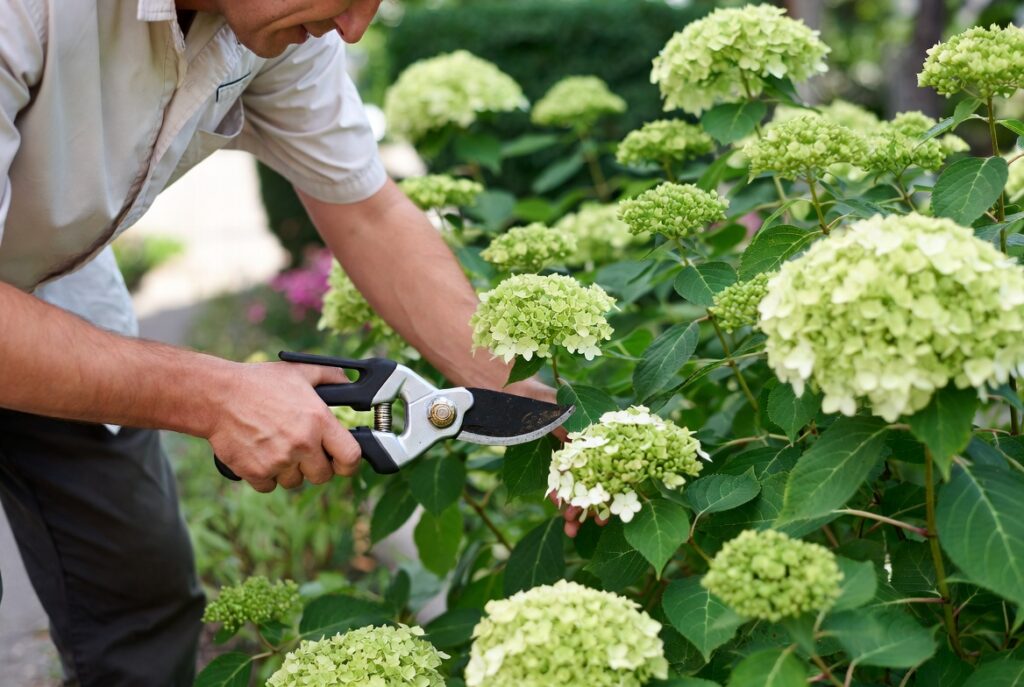
The Universal Step-by-Step Pruning Method for Hydrangea
Regardless of the species, certain procedures are universal to the maintenance of all hydrangea plants. These steps focus on the health and structural integrity of the shrub.
Step 1: Evaluating Viability Through the Scratch Test
Before making any cuts, the practitioner should assess which stems are alive and which have succumbed to winter dieback. This is particularly important in early spring. The “scratch test” involves using a thumbnail or blade to gently scrape a small section of the stem’s bark. If the tissue underneath is green, the stem is alive and possesses the capacity to produce leaves and flowers. If the tissue is brown and brittle, the stem is dead and should be removed.
Step 2: Removing the Three Ds
The second phase of pruning is the removal of wood that is dead, damaged, or diseased (the Three Ds). Dead wood should be cut back to the base of the plant or to the nearest set of healthy, live buds. Damaged stems—those that are cracked, broken, or rubbed raw by crossing branches—must be pruned back to healthy tissue. Stems showing signs of disease, such as unusual cankers or fungal growth, should be removed and disposed of away from the garden to prevent further spread.
Step 3: Improving Airflow and Light Penetration
Hydrangeas often become overly dense in their center, which can lead to high humidity and fungal issues like powdery mildew. The practitioner should identify stems that are crossing or growing inward toward the center of the shrub. Removing these “cluttering” stems opens up the structure, allowing sunlight and air to reach the interior, which promotes the development of healthy buds and reduces disease pressure.
Pruning Species that Bloom on Old Wood
The management of H. macrophylla, H. quercifolia, and H. serrata requires a “less is more” approach. Because these plants have already set their buds for the following year by late summer, the window for pruning is narrow.
Step-by-Step Pruning for Bigleaf and Mountain Hydrangeas
- Timing the Intervention: The ideal time to prune is immediately after the flowers have begun to fade in mid-summer. Pruning must be completed by early August to allow the plant time to recover and set new buds before dormancy.
- Deadheading the Blooms: To remove spent flowers, the cut should be made just above the first pair of healthy, full leaves below the flower head. This keeps the plant tidy without removing the nodes where next year’s flowers will emerge.
- Applying the One-Third Rule: For older, established plants (typically those older than five years), a rejuvenation technique is used. The practitioner identifies the oldest, woodiest stems—often recognizable by their gray, peeling bark—and cuts up to one-third of them down to the ground. This encourages the growth of vigorous new stems from the base.
- Managing Size: If the plant has grown too large for its space, the stems can be cut back more significantly, but this must be done with the understanding that it will reduce the following year’s bloom count.
Management of Oakleaf Hydrangeas
Oakleaf hydrangeas require very little pruning. They are often grown as much for their architectural form and fall color as for their flowers. Maintenance should be limited to the removal of dead wood in the spring and light shaping immediately after they finish blooming in early summer.
Pruning Species that Bloom on New Wood
The management of H. paniculata and H. arborescens is more flexible and can be used to influence the size and quantity of the flowers produced.
Step-by-Step Pruning for Smooth Hydrangeas (H. arborescens)
- Late Winter Pruning: In late February or early March, before the sap begins to rise, the plant should be evaluated for its desired form.
- Hard Pruning for Large Flowers: For varieties like ‘Annabelle’, many practitioners choose to cut the entire plant back to within 6 to 12 inches (15 to 30 cm) of the ground. This stimulates the production of massive flower heads.
- Maintaining Structural Integrity: A known drawback of hard pruning is that the new, vigorous stems may be too weak to hold up the heavy flowers during rain. To counter this, a “framework” approach can be used, where stems are cut back to varying heights between 1 and 2 feet (30 to 60 cm) to provide more support for the new growth.
Step-by-Step for Panicle Hydrangeas (H. paniculata)
- Dormant Season Timing: These should be pruned in late winter or very early spring before they begin to leaf out.
- Thinning for Shape: The practitioner should remove thin, spindly branches that are unlikely to support large flowers.
- Heading Back Main Stems: The main structural stems should be cut back by about 30\% to 50\% of their length. The cut should be made just above a pair of healthy buds. This results in a more compact, rounded shrub with larger cone-shaped blooms.
- Tree-Form (Standard) Maintenance: If the hydrangea has been trained as a tree, the central trunk must never be cut. Only the branches forming the “head” or canopy should be pruned back to a few buds each spring to maintain the rounded shape.
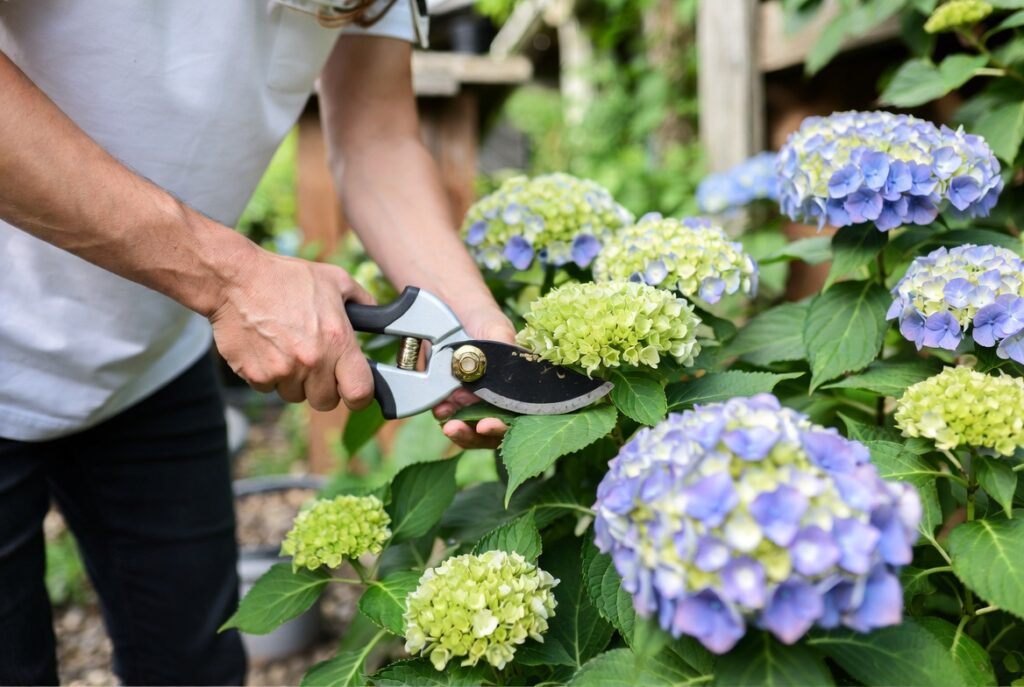
Pruning Techniques for Reblooming (Remontant) Varieties
Reblooming hydrangeas, such as the ‘Endless Summer’ series, represent a unique challenge because they possess the capacity to flower on both old wood and new wood.
Strategic Maintenance for Maximum Bloom
The most effective strategy for these varieties is to treat them as if they bloom exclusively on old wood to preserve the early summer flower buds. In the spring, only the dead wood should be removed. Once the first flush of flowers has faded in early summer, deadheading them will stimulate the plant to produce a second set of flower buds on the new growth, extending the blooming season into the autumn.
The Mechanics of Cutting You Should know
The physical act of cutting a hydrangea stem is governed by rules designed to prevent rot and promote rapid healing.
The 45-Degree Rule
Every pruning cut should be made at a 45-degree angle. The slant should face away from the bud. This geometry ensures that rainwater and dew slide off the cut surface rather than pooling on top of it. Stagnant moisture on a fresh wound is a primary vector for fungal infections that can travel down the stem and kill the emerging buds.
Precision Placement
The cut should be placed approximately 1/4 inch (0.635 cm) above a pair of healthy, viable buds or a node. Cutting too close to the bud can cause it to dry out and die, while leaving a large “stub” above the bud can lead to rot as the plant cannot effectively heal wood that has no active growth beyond it.
| Cut Quality | Potential Impact on Plant Health | Botanical Consequence |
|---|---|---|
| Clean, Angled Cut | Rapid callus formation | Minimal risk of pathogen entry |
| Jagged/Crushed Cut | Tissue necrosis | High risk of fungal infection |
| Flat Cut | Water pooling | Risk of stem rot |
| Too Far Above Node | Dieback of the “stub” | Aesthetic degradation and rot risk |
Common Pruning Pitfalls: What to Avoid
Expert gardeners identify several key mistakes that can compromise the performance of hydrangeas. Awareness of these “traps” is essential for long-term success.
The “Height Mistake”
A frequent error is pruning a hydrangea throughout the growing season in an attempt to keep it shorter. Because pruning stimulates new growth, the plant often responds by growing back even faster, frequently returning to its original size or larger by the end of the season. Furthermore, constant trimming often removes the very nodes where flower buds would have formed. The more effective solution is to choose a variety that has a mature height suitable for the intended location.
Autumn Tidying Risks
Many individuals feel the urge to “clean up” the garden in the autumn. However, for most hydrangeas, autumn is the worst time to prune. For old wood species, it removes the next year’s blooms. For all species, pruning late in the season can stimulate a flush of new growth that is tender and susceptible to being killed by the first hard frost.
Conclusion
The technical management of hydrangea pruning is an interplay between botanical knowledge and seasonal timing. By mastering the distinction between old and new wood, the professional practitioner can manipulate the growth of the shrub to achieve specific aesthetic goals—whether that is the production of massive showpiece blooms or the maintenance of a tidy, architecturally sound landscape feature. The key to success lies in observation: identifying the species, assessing the health of the wood through diagnostic tests, and executing precise, angled cuts that respect the plant’s natural healing processes. When pruning is integrated with proper soil management and winter protection, the hydrangea remains one of the most rewarding and resilient specimens in the managed garden.
Frequently Asked Questions
The most likely cause is pruning at the wrong time. If the plant is an old wood variety (like a Bigleaf or Oakleaf) and was pruned in the late autumn, winter, or early spring, the flower buds were inadvertently removed. Other potential causes include a late spring frost that killed the buds, or an excess of nitrogen in the soil, which favors leaf growth over floral production.
Yes, but this is typically only successful with Hydrangea paniculata varieties. It requires selecting a single strong vertical stem while the plant is young and removing all other stems. Over time, the lower branches are removed to create a trunk, and the top is pruned to create a rounded canopy.
If the plant blooms on old wood, June is an excellent time to prune, provided it has finished flowering. If it is a new wood variety, June is generally too late, as the plant has already begun developing its flower buds for the summer; pruning now would remove this year’s blooms.